EmpCo: Preventing greenwashing with the Blue Angel
Advertising claims about the environmental benefits of products, such as ‘eco’, ‘sustainable’, ‘climate-neutral’ or ‘recyclable’, and ecolabels have so far been subject to very little regulation. This is about to change: stricter regulations against greenwashing will be in place from 27 September 2026 with the EU directive ‘Empowering Consumers for the Green Transition’ (Directive (EU) 2024/825, EmpCo for short). The Blue Angel is highlighted by the legislation as demonstrating ‘recognised excellent environmental performance’ and makes it easier to communicate environmental benefits.
The directive amends and supplements the existing ‘Unfair Commercial Practices Directive’ (2005/29/EC) and the ‘Consumer Rights Directive’ (2011/83/EU). The directive entered into force on 26 March 2024 and will be applied from 27 September 2026. With the ‘Third Law Amending the Act Against Unfair Competition (UWG)’ (only in German), Germany implemented Article 1 of the EU directive, which concerns environmental advertising claims.
The aim is to enable consumers to make better-informed purchasing decisions with regard to environmental impacts and thus contribute to more sustainable consumer behaviour.
In terms of product labelling, this means:
- In the future, environmental claims must be justified, verifiable and transparent and must not be presented in a misleading way.
- Certain types of climate-related advertising are not permitted.
- Sustainability labels must be based on transparent certification schemes or established by government authorities.
- Environmental claims about the product as a whole, although they only apply to part of it, are prohibited.
- Statutory requirements must not be advertised as special characteristics.
- Claims relating to future environmental performance (such as a company that will become climate-neutral in the future) must be transparent and verifiable.
- In the case of comparative environmental claims, the comparisons must be objective and be made based on a standardised method and standardised assumptions.
The Blue Angel makes it possible for companies to continue to communicate the environmental benefits of products and services in a credible way. As a government ecolabel, it is based on an independent assessment and awarding procedure (certification scheme). Products with the Blue Angel are also considered to demonstrate ‘recognised excellent environmental performance’, meaning that simplified environmental claims such as ‘environmentally friendly’ continue to be permitted in text and within product names. Claims such as ‘low level of harmful substances’ also do not need to be substantiated in detail if they are covered by the ecolabel’s criteria.
Blue Angel is EmpCo-compliant
The Blue Angel ecolabel can also continue to be used to highlight particularly environmentally friendly products and services in the future. In accordance with No. 2a of the Annex to Section 3(3) of the German Act Against Unfair Competition (UWG), as amended, it will always be prohibited in the future to display a sustainability label (also referred to as quality marks/labels that highlight environmental and/or social benefits) in relation to consumers that is not based on a certification scheme and has not been established by government authorities.
The Blue Angel is a government label and also fulfils the requirements on a certification scheme, which will be governed in the future in Section 2(2) No. 6 UWG, as amended, (“certification scheme”):
“[…] a third-party verification scheme that confirms that a product, process or business complies with certain requirements, that allows for the use of a corresponding sustainability label, … the terms of which, including its requirements, are publicly available and meet the following criteria:
- the scheme is open to all entrepreneurs under transparent, fair, and non-discriminatory terms;
- the scheme’s requirements are developed by the scheme owner in consultation with relevant experts and stakeholders;
- the scheme sets out procedures for dealing with non-compliance with the scheme’s requirements and provides for the withdrawal or suspension of the use of the sustainability label by the entrepreneur in case of non-compliance with the scheme’s requirements; and
- the monitoring of an entrepreneur’s compliance with the scheme’s requirements is subject to an objective procedure and is carried out by a third party whose competence and whose independence from both the scheme owner and the entrepreneur are based on international or Union standards and procedures or on standards and procedures of a member state of the European Union.”
Use of generic environmental claims in text or within a product name
In communication regarding products or services with the Blue Angel, generic environmental claims, i.e. environmental claims in an abbreviated form such as ‘environmentally friendly’ or ‘low level of harmful substances’, can also be used in the future without having to be justified in detail. In addition, generic environmental claims are possible within product names. However, generic claims must be covered by the ecolabel’s criteria. This possibility results from the classification of the Blue Angel as demonstrating ‘recognised excellent environmental performance’.
The corresponding provision is derived from the ban on the use of generic environmental claims: “Making a generic environmental claim for which the entrepreneur is unable to demonstrate recognised excellent environmental performance on which it is based” in relation to consumers is always prohibited in accordance with No. 4a of the Annex to Section 3(3) UWG, as amended.
As a national, officially recognised ecolabel in the Member States, the Blue Angel is highlighted as demonstrating ‘recognised excellent environmental performance’ in accordance with ISO 14024. The same applies to the EU Ecolabel and to the highest energy efficiency class of the Energy Label (Section 2(2) No. 2 UWG, as amended, “recognised excellent environmental performance”). Exemptions from the communication requirements exist for products or services displaying these labels. Irrespective of this, the ban on misleading commercial practices continues to apply (Section 5 UWG).
Information on the use of generic environmental claims in text
The Blue Angel provides a dedicated explanatory box (see image) for each product group. The claims contained in this, such as ‘low level of harmful substances’ or ‘manufactured using water-saving methods’, can continue to be used with the Blue Angel ecolabel without detailed justification, as they are understood to be generic claims. However – as already described above – they must be covered by criteria for the specific product group or service.
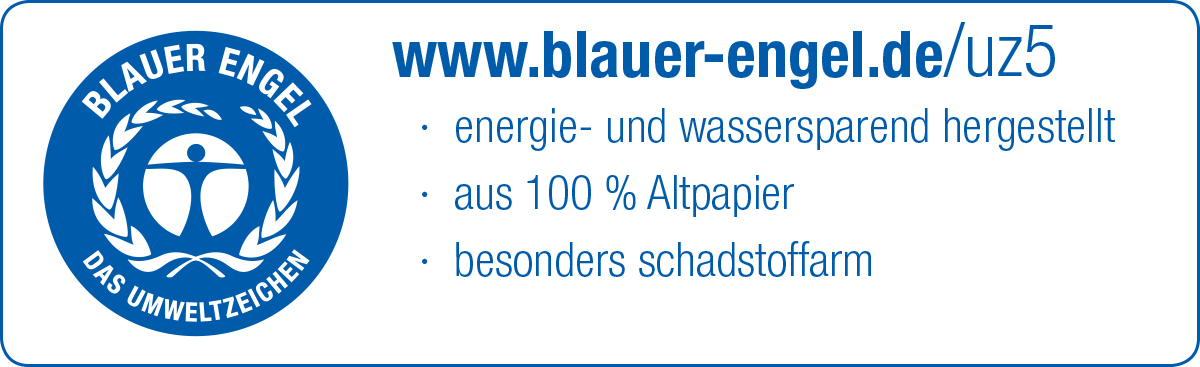
The Blue Angel offers an explanatory box with a maximum of three key criteria for each ecolabel.
(Example of sanitary paper)
Terms such as ‘environmentally friendly’, ‘eco-friendly’ and ‘green’ continue to be possible with the Blue Angel ecolabel, as it demonstrates ‘recognised excellent environmental performance’ by indicating products with lower environmental impacts throughout their entire lifecycle. They can be used with the Blue Angel ecolabel without detailed justification, but must be covered by criteria for the specific product group or service within the respective ecolabel.
Other generic environmental claims can be made in text by the manufacturer or distributor under their own responsibility as long as they are covered by the criteria of the respective ecolabel.
Similarly, in accordance with EmpCo, further environmental claims can be made on topics that are not addressed within the Blue Angel Basic Award Criteria. These claims are also the responsibility of the manufacturer or distributor and must then be specified in or on the same medium.
Detailed explanations of how generic environmental claims can be used in the event of recognised excellent environmental performance can be found in the Questions & Answers document from the EU Commission (English, No. 7).
Restrictions for mixtures
The following restriction on generic environmental claims must be taken into account for products that are mixtures under chemicals law (e.g. detergents, cosmetics, paints): If products are classified as hazardous in accordance with the regulation on classification, labelling and packaging (CLP Regulation), they must comply with Article 25(4) of the stated regulation. Statements such as ‘non-toxic’, ‘non-harmful’, ‘non-polluting’, ‘ecological’ or any other statements indicating that the substance or mixture is not hazardous or any other statements that are inconsistent with the classification of that substance or mixture shall not appear on the label or packaging of any substance or mixture.
Information on the use of generic text statements in product names
The provisions of UWG/EmpCo also relate to generic environmental claims within product names. An exception also exists here for the Blue Angel ecolabel, which is explained in the Questions & Answers document from the EU Commission (No. 3). The possibility of using generic environmental claims such as ‘green’ or ‘eco’ in the product name without further specifying this on the same medium results from the classification of the Blue Angel as demonstrating ‘recognised excellent environmental performance’. Here, too, however, the generic environmental claim must be covered by the criteria and fulfilled by the product. In particular, for parts of names that are associated with bio-based raw materials or organic farming, it thus appears sensible to assess whether an adequate basis exists for this in relation to the specific products.
However, for some Blue Angel ecolabels, such as for wall paints (DE-UZ 102), lubricants (DE-UZ 178) and nappies (DE-UZ 208), the use of certain terms as part of the name is restricted by the Blue Angel criteria.