
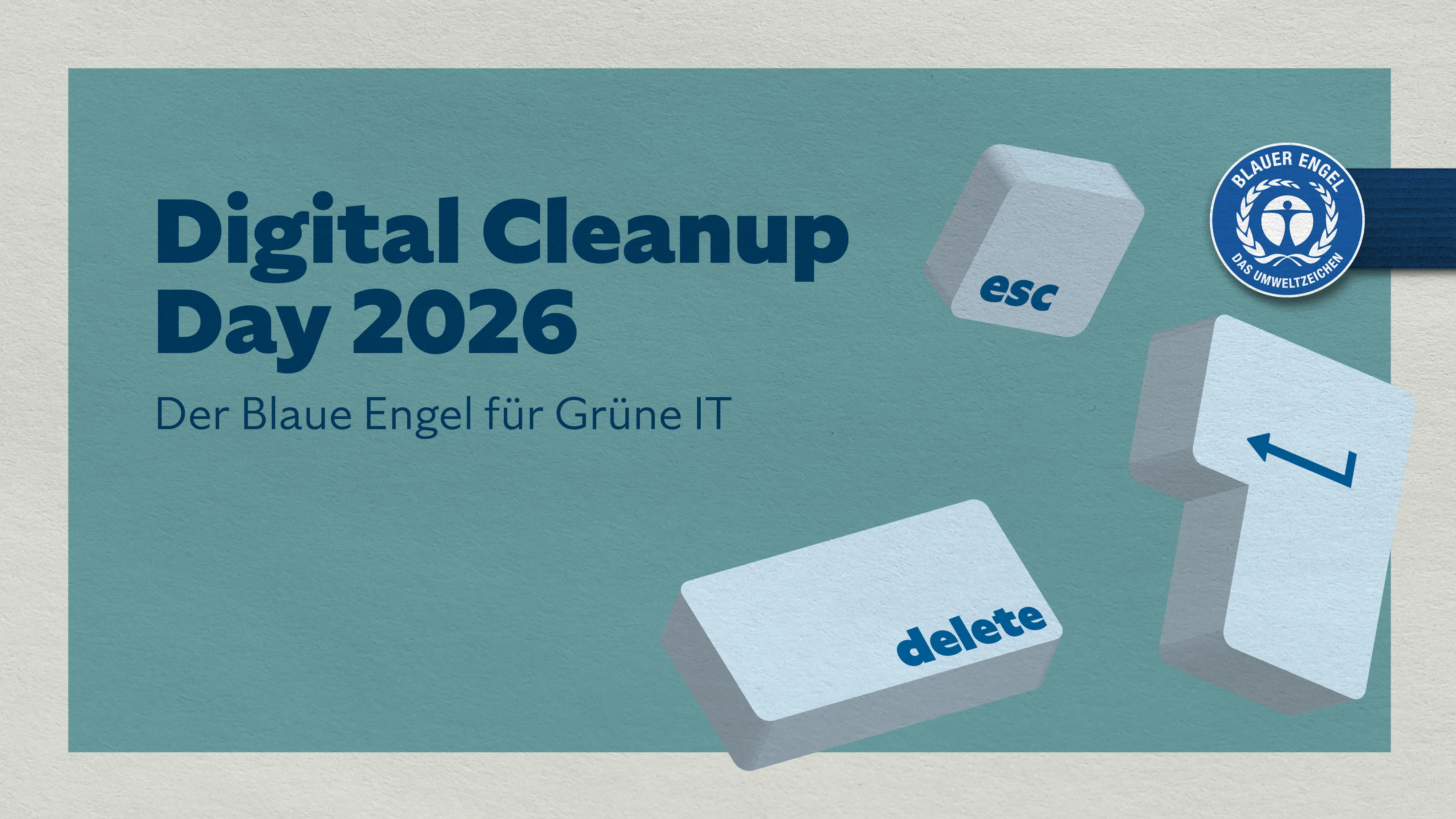
Dessau – They are only invisible at first glance: data packets. They are exchanged between data centres around the world in a matter of seconds and drive the flow of commodities and knowledge-based work. Even archived – sometimes long-forgotten – data uses energy. Despite its relevance in private and professional everyday life, the energy consumption of digital data storage and inefficient software is rarely on most users’ proverbial radar. The Blue Angel is drawing attention to this on this year’s Digital Cleanup Day and recommends giving your hard drive a spring clean.
Anna Zagorski, green IT expert at the German Environment Agency (UBA), says: “Data hygiene, sometimes also intentionally clicking on the 'delete' button, is still equated with sacrifice. A clean hard drive actually not only helps us keep things in order. Everyone benefits – the environment due to lower energy consumption and the user due to a clear view of their own digital identity. And the Blue Angel helps when looking at suitable products.”
Green IT: the Blue Angel provides guidance
The government ecolabel offers reliable information on the environmental benefits of digital tools in Germany. Whether this concerns Software, that is programmed to save energy and data, energy-efficient data centres, low-emission printers or low-pollutant computer mice that are easy to repair. Strict, independent criteria that are regularly updated in line with the latest science and research boost credibility in the green IT sector. The Blue Angel thus shows the diversity and breadth of its certifications. The ecolabel established in 1978 has long been awarded to much more than just paper and stationery, cleaning agents and construction products.
In light of the wide variety of Blue Angel certifications, Anna Zagorski points out: “If we look at the current boom in artificial intelligence, the huge amount of computing power soon becomes apparent. Clear standards are needed to prevent our environment and the availability of resources from suffering as virtual capabilities increase. Hardware and software certified with the Blue Angel follow these standards. This gives end consumers and public procurement a clear indicator of high-performance and long-lasting digital solutions.”
The Blue Angel for green IT – this is only an advantage for users: data centres can demonstrate to their clients and competitors that they are energy-efficient and their services are climate-friendly. Software developers also benefit. The Basic Award Criteria for the Blue Angel offer them the necessary guidance to identify possible weaknesses in the software at an early stage and implement suitable measures to reduce the environmental impact.
Tracking down “data waste”: tips for tidying up
Digital Cleanup Day has been dedicated to raising awareness of people’s own digital environmental footprint for the last six years. A look at this year’s figures once again shows how long-lasting the impact of data transferred in milliseconds can be. According to information on the official Digital Cleanup Day website, the 900 million tonnes of CO2 emissions produced annually by the Internet and its supporting systems are increasing rapidly.
By following these steps on their smartphones, tablets and PCs, consumers can contribute towards digital energy and resource efficiency:
- Check user accounts: Is the account still in use? Deleting orphaned accounts also boosts the integrity of private data.
- Dispose of digital “waste”: Files, programs and e-mails that are no longer required and photos and videos that are already stored elsewhere (duplicates) are considered digital “waste” and can be deleted.
- Check backups, servers and cloud services: Archived data also increases the digital environmental footprint – due to the energy required for cooling and data transfer as well as the raw materials needed for additional storage space. Checking backup routines and deleting data where necessary can help.
- Remove the waste completely: Regularly emptying the desktop recycle bin also helps free up storage space.
Anna Zagorski from the UBA is available for queries or an interview.